lunedì 15 dicembre 2014

First Certificate Use of English Part 2

Go to the link below and practise the Use of English Part 2 exercise from the online Exam Practice site

http://www.examenglish.com/FCE/fce_use_of_english_part2.htm


giovedì 11 dicembre 2014

Causative Verbs

Causative Verbs

Have a go at this exercise.

Choose the correct verb for each sentence by clicking one of the answers(a-d).

Causative Verbs


giovedì 20 novembre 2014

Past ability and possibility


Past ability & possibility

 
In the present tense we use ‘can’ to talk about a general ability – e.g. I can swim – and also for ability at a particular moment – e.g. I can see you! The rules for talking about past abilities are different.

General ability

We use could to talk about general abilities in the past.
  • He could speak fluent French when he was 5.
  • I could read before I started school.
Ability on one occasion

However, when we talk about ability on one particular occasion, we can’t use could
  • The burglar was able to get in through the bathroom window.
  • The burglar managed to get in through the bathroom window.
We have to use was able to or managed to. We can’t use could.
  • The burglar could get in through the bathroom window.
Ability on one occasion - negative

When we talk about a particular occasion when something wasn’t possible, we can use wasn’t/weren’t able todidn’t manage to, or couldn’t
  • The burglar wasn’t able to get in through the window.
  • The burglar didn’t manage to get in through the window.
  • The burglar couldn’t get in through the window.
Hypothetical past ability

Sometimes things were possible in the past but didn’t happen.
  • I could have gone to university but I decided to get a job.
  • I would have been able to win the race but I fell over.
We use could have (+ past participle) or would have been able to to talk about these hypothetical events. They can be used in the positive and the negative.
  • I couldn’t have done it without your help.
  • I wouldn’t have been able to afford it even if it had been for sale.
- See more at: http://learnenglish.britishcouncil.org/en/grammar-reference/past-ability-possibility#sthash.JddrcE1x.dpuf

Click here to practise


giovedì 30 ottobre 2014

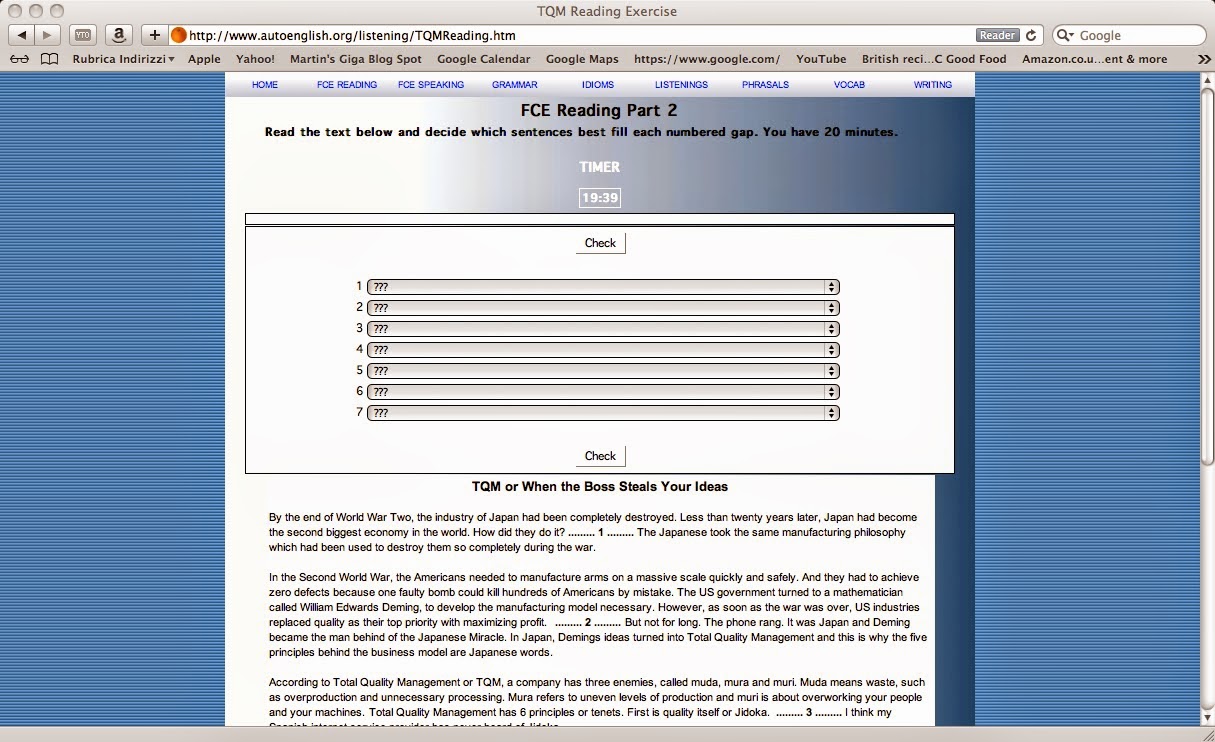
First Reading Part 2 (removed sentences)

Go to the link below and complete the Auto English online FCE Reading Part 2 exercise.

You must not take more than 20 minutes to complete the exercise

http://www.autoenglish.org/listening/TQMReading.htm


martedì 21 ottobre 2014

Past Simple versus Present Perfect

Can you identify the correct form for talking about finished actions and continuous actions which began in the past?

Look at these exercises and use the time marker adverbials to help you identify when to use the past simple form and when to use the present perfect form.


Passive Question Form


The Passive Voice in Questions Exercise

Why hasn’t the washing-up been done?

Change the sentences from the active to the passive.

1 Do they make cars in Korea? ........................................................................................................ ?
2 Do the hounds kill the fox? ................................................................................................................................... ?
3 Will The King inaugurate the new bridge? ........................................................................................................ ?
4 Is a doctor going to examine you? ........................................................................................................ ?
5 Did the bull kill the matador? ........................................................................................................ ?
6 Did they catch the thief? ...................................................................................................................................?
7 When did they hijack the plane? ...................................................................................................................................................?
8 How did your host family treat you? ........................................................................................................ ?
9 Have the police found the body? ...................................................................................................................................?
10 Has anyone cleaned the oven yet? ........................................................................................................ ?
11 Why has the government banned the film? ........................................................................................................ ?
12 Would Tai Chi classes interest you? ...................................................................................................................................................?

www.autoenglish.org Written by Bob Wilson ©Robert Clifford McNair Wilson 2007
Modals of Deduction

Practise this modal verb of deduction online exercise from Auto-English

http://www.autoenglish.org/modalverbs/pastmodalsdeduction.htm


Past Modal Verbs of Deduction Exercise
She must have gone out
I might have made a mistake
He can't have been there.
You should have apologised
You shouldn't have said that.

- There is strong evidence. - There is a possibility that I made a mistake. - It's impossible. - A criticism - A criticism


A Fill the gaps with must have, might have or can't have.

1 She ................................studied really hard. She passed all her exams with excellent grades.
2 You ................................ shouted at him. He'll never forgive you.
3 He ................................ arrived by now. It's only a 20 minute journey.
4 The concert was fantastic. You really ................................ come.
5 The boss is in a terrible mood. The meeting ................................ been good.
6 Sarah ................................ been so happy when she found out she was being promoted.
7 I had to wait 45 minutes for a bus yesterday. There ................................ been an accident or maybe a strike.
8 He ................................ bought a new car. He doesn't have any money.
9 Andrew did no revision for the exam but he's passed. I think he ................................ cheated.
10 I left my bicycle in front of the library and it's disappeared. Someone ................................ stolen it.
11 Clara was very upset with you yesterday. You ................................ apologised for saying she was lazy.
12 John has forgotton about the meeting. We ................................ reminded him about it yesterday.
13 I'm sorry but Samantha isn't here. She ................................ already left the office.
14 You ................................ tried to fix the roof yourself. You might have fallen off and been badly injured.
15 He ............................ known it was your birthday. Otherwise, I'm sure he would have wished you a happy day.


B Now write some examples of your own.

1 ..........................................................................................................................................
2 ..........................................................................................................................................
3 ..........................................................................................................................................
4 ..........................................................................................................................................

www.autoenglish.org Written by Bob Wilson ©Robert Clifford McNair Wilson 2013
Word Transformation (Modals)

Here's an online word transformation exercise from Auto-English

Follow the instructions using the arrow to move on or clicking the buttons for help or correct answers


Click here to go to the link


Can, Could, May and Might Exercise

Use one of the modal verbs in brackets to fill each gap.

1 They (can/might)........................... be away for the weekend but I'm not sure.
2 You (may/might)........................... leave now if you wish.
3 (Could/May)........................... you open the window a bit, please?
4 He (can/could)........................... be French, judging by his accent.
5 (May/Can)........................... you play the piano?
6 Listen, please. You (may not/might not)........................... speak during this exam.
7 They (can't/may not)........................... still be out!
8 You (couldn't/might not)........................... smoke on the bus.
9 With luck, tomorrow (can/could)...........................be a sunny day.
10 You (can/might)........................... be right but I'm going back to check anyway.
11 The exam (can/might)........................... be easy. You never know.
12 I (can/might)........................... go to the party but I'm not sure yet.
13 Students (may/might)........................... study in the library from five to nine in the evening.
14 (May/Could)........................... you lend me 40 Euros til Monday?


lunedì 20 ottobre 2014


QIS Learners Questionnaire

Please go to the link below and complete the online questionnaire.

mercoledì 15 ottobre 2014

Unit 9 and 10 Grammar and Vocabulary Revision


venerdì 10 ottobre 2014

First Speaking Test Part 3

Describing pictures

Watch this video clip of part 3 of the First Speaking Test and make a note of the modal verbs and thier functions.
Decide who spoke the most and who you think was the better candidate.
Write a list of adjectives that you heard them using during the test.

Click here to go to the link

mercoledì 8 ottobre 2014

FCE Use of English Part 4

Use of English Practice - Part 4 - Word Transformation

Have a go at resolving these questions from FCE Use of English Part 4.

Rewrite the sentences so that they have the same meaning as the example given. Use the modal verb provided. Use the hint if you are stuck.

Also try the second exercise in the second link below. This time remember to change between active and passive voice in order to maintain the significance of the original sentence.

Click here to go to the link

http://www.autoenglish.org/FCEUse/ReportedSpeechTransformations.htm


sabato 4 ottobre 2014

Modals for Deduction


Modals – deduction (present)


Read the grammar reference below and then try the exercise from the link below
 

Modals – deduction (present)

We use modal verbs to say how sure we are about something.

1 must

We use must when we feel sure that something is true because there’s very strong evidence.
  • He must live near here because he comes to work on foot. We don’t know where he lives but we’re sure it’s not far away.
  • Come inside and get warm – you must be freezing out there.
  • You’re a zookeeper? That must be very interesting.
Notice that must is followed by an infinitive without ‘to’.

2 might, may, could

We use mightmay or could to say that we think something is possible but we’re not sure.
  • Did you hear that? I think there might be a burglar downstairs. She’s not sure there’s a burglar but she thinks it’s possible.
  • We’ll try to get there early but we may arrive late if there’s a lot of traffic.
  • Don’t put it up there. It could fall off and hit someone.
Mightmay and could are also followed by an infinitive without ‘to’.

3 can’t

We use can’t when we feel sure something is not true.
  • It can’t be a burglar. All the doors and windows are locked. He doesn’t know it’s not a burglar but he feels sure it’s not.
  • It can’t be far away now. We’ve been driving for hours. Where’s the map?
  • Really? He has to work on Christmas Day? He can’t feel very happy about that.
Like the other verbs, can’t is followed by an infinitive without ‘to’.

Remember that all of these modal verbs – mustmightmaycould and can’t have other uses. These are covered in another section.
- See more at: http://learnenglish.britishcouncil.org/en/grammar-reference/modals-deduction-present#sthash.aCsc5svX.dpuf

Click here to go to the British Council link


Changes to FCE


Changes to First Certificate 2015

Have you been asking yourself how First test papers are changing for 2015?

Check out the official Cambridge English website for updated details on the changes to test papers for the year 2015.


mercoledì 1 ottobre 2014

Delexical Verbs

Delexical Verbs

Sometimes you transfer verbs from your first language into English language, but they can be false friends or incorrect for the context.

This commonly happens with verbs such as make, do and have, for example.
Do you make a shower or have a shower?

Practise your knowledge of these verbs with the exercises in the link below.

British Council English Grammar - Delexical Verbs


Verbs and Prepositions


Verbs and Prepositions

Do you know which preposition to use after each verb?

Try this fun exercise from British Council.
Choose a preposition for each question and type your answer. Then check your final score or press HELP for a clue.


sabato 27 settembre 2014


Welcome!

Here, you will find instructions, if any, regarding your homework and advice for your personal development.
Please check this page regularly as well as when asked to. I may also often refer you to my Homepage where you can find many useful and interesting links and news updates about English language and the school.

Happy studying!

martedì 13 novembre 2012

Time & Place Phrases + 'in', 'at, and 'on'.

http://www.bbc.co.uk/worldservice/learningenglish/grammar/learnit/learnitv246.shtml

http://www.bbc.co.uk/worldservice/learningenglish/grammar/learnit/learnitv61.shtml


Learn It
Colour idioms
Michal Juda from Poland writes:
 Learning with colours was a leitmotif of Learning English recently. Can you help me to understand two of the expressions:whiter than white and paint the town red?
 
 
Roger Woodham replies:
 
We have many idiomatic expressions involving the whole range of colours in English. In answering your question, Michal, we will have a look today at just three colours: red, white and blue (the colours of our national flag).
 
white colour idioms
 
White in British culture is traditionally associated with purity and innocence. See if you can work out the meaning of the following white colour idioms word for word. Then check your understanding by reading examples of how they are used in context. Finally, check again against the explanations given.
 
go as white as a sheet
white coffee
a white-collar worker
tell a white lie
whiter than white
 
The news must've been bad. She went as white as a sheet when she read the telegram.
 
- Do you want white or black coffee? - White please. Well, dark brown, actually - just a dash of milk.
 
He hopes to get a white-collar job, though, with his level of education, he'll be lucky to get a blue-collar one.
 
It's OK to tell a white lie. It doesn't do any harm and it nearly always does some good.
 
She's whiter than white - the image of perfection. In her entire life she has never put a foot wrong.
 
go as white as a sheet: become extremely pale in the face
 
white coffee: coffee with milk (note: not white tea; instead: tea with milk)
 
white-collar worker: an office worker (note blue-collar = factory or physical work)
 
tell a white lie: telling a lie to avoid making someone upset
 
whiter than white: someone who is totally fair and honest
 
red colour idioms
 
Red is often associated with anger or danger (red traffic lights). In British culture, red-haired people (redheads) are traditionally hot-tempered and high-spirited. Try to work out the meaning of these red colour idioms in the same way as before.
 
be in the red
see red
roll out the red carpet
paint the town red
a red-letter day
 
She's always in the red, never in the black. No overdraft would ever be big enough for her.
 
When she realised saw that no housework had been done all week, she saw red and banished us from her holiday home.
 
It'll be time to roll out the red carpet when Auntie Meg returns home. We haven't seen her for twenty years.
 
They decided they would paint the town red after winning so much money by gambling on the horses.
 
It was a red-letter day for us when we were able to move into our new holiday house - the house of our dreams.
 
be in the red: have minus amounts on one's bank account (in the black = in credit)
 
see red: lose one's temper; become suddenly angry
 
roll out the red carpet: put on a special welcome for an important person
 
paint the town red: enjoy yourself by going to bars and/or clubs
 
a red-letter day: a very happy or exciting day
 
blue colour idioms
 
Blue is traditionally the colour of boys' clothes in British culture - pink for girls. It is also associated with loyalty and true love. Try to work out the meaning of these blue colour idioms in the same way as before.
 
a blue movie
out of the blue
scream blue murder
the boys in blue
a blue-eyed boy
 
Blue movies, or adult videos as they are sometimes called, are normally only available from sex shops.
 
His suggestion that we should move to Cyprus came completely out of the blue. I wasn't expecting it.
 
They started to scream blue murder when I told them they would have to work an extra half an hour on Saturday afternoons.
 
It's a criminal offence. We can't sweep it under the carpet. We should hand it over to the boys in blue.
 
He's the blue-eyed boy of skateboarding all right. He's won this competition five times.
 
a blue movie: a film with explicit adult scenes
 
out of the blue: suddenly and unexpectedly
 
scream blue murder: make a lot of fuss; shout loudly and emotionally in protest
 
the boys in blue: the uniformed police
 
a blue-eyed boy: a young man (grudgingly) admired because he is successful
Laptop learning in Italy

Read and listen to the article from BBc's 'Words in the News'.
Continue to read about computers in the follow-up article from BBC's 'One-minute World News'.


BBC Learning English
Words in the news
8th October 2008
Laptop learning in Italy
Words in the news © British Broadcasting Corporation 2008
Page 1 of 2
bbclearningenglish.com
Children at a school in Italy have today begun an experiment to replace all their books with
personal computers. The pupils involved will each be given a special laptop that contains
their entire curriculum. From Rome our correspondent Duncan Kennedy reports:
Until today, the Don Milani di Rivoli elementary school in central Turin was like any other.
Children turned up, got out their books and pens and began the process of learning. But now,
in what's being described as a unique experiment, 60 fifth-grade pupils and a number of thirdgraders,
will start using computers only.
The mini-laptops, which run Windows software, all have a full curriculum programmed into
them. The pupils will use the computers to do all their reading and writing. Security systems
within the laptops mean the children's access to the internet is strictly controlled. The
machines weigh less than a kilogram, can be dropped from a height of 1.5 metres and are
waterproof.
Instead of spending the equivalent of 700 dollars a year on books, the laptops, built by the
Italian company Olidata, cost less than 400 dollars. One of the teachers involved in the
scheme says that, for the first time, schools will be able to verify in a scientific way how a
computer alone can improve the learning process. The experiment, which has the backing of
parents, is due to last a year.
Duncan Kennedy, BBC News, Rome
Words in the news © British Broadcasting Corporation 2008
Page 2 of 2
bbclearningenglish.com
Vocabulary and definitions
elementary school a school that provides the first part of a child's education
(usually for children aged 5 - 11)
turned up here, came to school
grade a class or group of classes in a school where all the
children are of a similar age and/or ability
curriculum all the subjects taught at a school, college, university etc.
The word 'curriculum' can also be used to mean the same
as 'syllabus', i.e. the topics or books studied within a
subject
access to here, ability to surf/search/use
are waterproof cannot be damaged by water
the equivalent of the sum of money that amounts to/equals
involved in the scheme taking part in the experiment
to verify to prove that something is true or not
backing support, encouragement
More on this story: http://news.bbc.co.uk/2/hi/technology/7642985.stm
Read and listen to the story and the vocabulary online:
http://www.


http://www.bbc.co.uk/worldservice/learningenglish/newsenglish/witn/2008/10/081008_italy_laptops.shtml